
Beyond the Packaging: A Guide to Building an Affordable Pantry.
I have spent a considerable amount of time in the supermarket food aisles, calling it my latest quirk or a newfound obsession. Be it yogurt, nut butters, protein bars, or dark chocolates. Comparing labels, ingredients, and cost per item before deciding what makes it into my shopping basket.
The peanut butter aisle in KL offered plenty of choices, and so did the yogurts & protein bars. Every pack looked more appealing than the last until I turned it around to read the ingredients. That’s where the packaging often lost all its charm.
Back in India, Pintola Crunchy was my go-to peanut butter. In KL, Jobbie’s caught my attention as a potential alternative. But rather than relying on packaging or marketing claims, I wanted to understand what was actually in the jar.
As a runner, I burn approximately 2,000+ kcal a day, depending on my training and activity levels. Carbohydrates are my primary fuel source, while protein plays an important role in recovery. I check labels for several reasons: ingredients, nutritional composition, serving sizes, and whether a product fits into my everyday diet.
My search for yogurt followed a similar path. Milky Mist Greek yogurt was a familiar choice back home. In KL, I began exploring Sunglo and Marigold Greek yogurt, along with other locally available options.
These aren’t necessarily identical products. They are the alternatives I’m exploring, and comparing their labels is part of figuring out what works best for me.
A quick disclaimer: none of the brands mentioned here have sponsored this article. These are personal shopping choices and products I’m researching for everyday use, not a blanket endorsement of their nutritional quality.
The nutritionist’s dilemma: eating well without overspending
One of the things I’m cognizant of as a nutritionist is affordability. Building a nutritious pantry shouldn’t mean buying every product marketed as healthy or performance-enhancing. According to me, food is not a project; it’s a lifestyle. The choices we make need to be practical enough to sustain over months and years.
My preference is to build meals around everyday food, including fresh produce and locally available ingredients, and use convenient products. Protein powders and bars can be useful when time, travel, training schedules, or access to food make them practical. They don’t have to replace a well-planned diet.
My India-to-KL pantry comparison
Here are some of the products I’ve been researching as I rebuild my everyday pantry. This is a working list of familiar products and potential alternatives, rather than a definitive ranking.
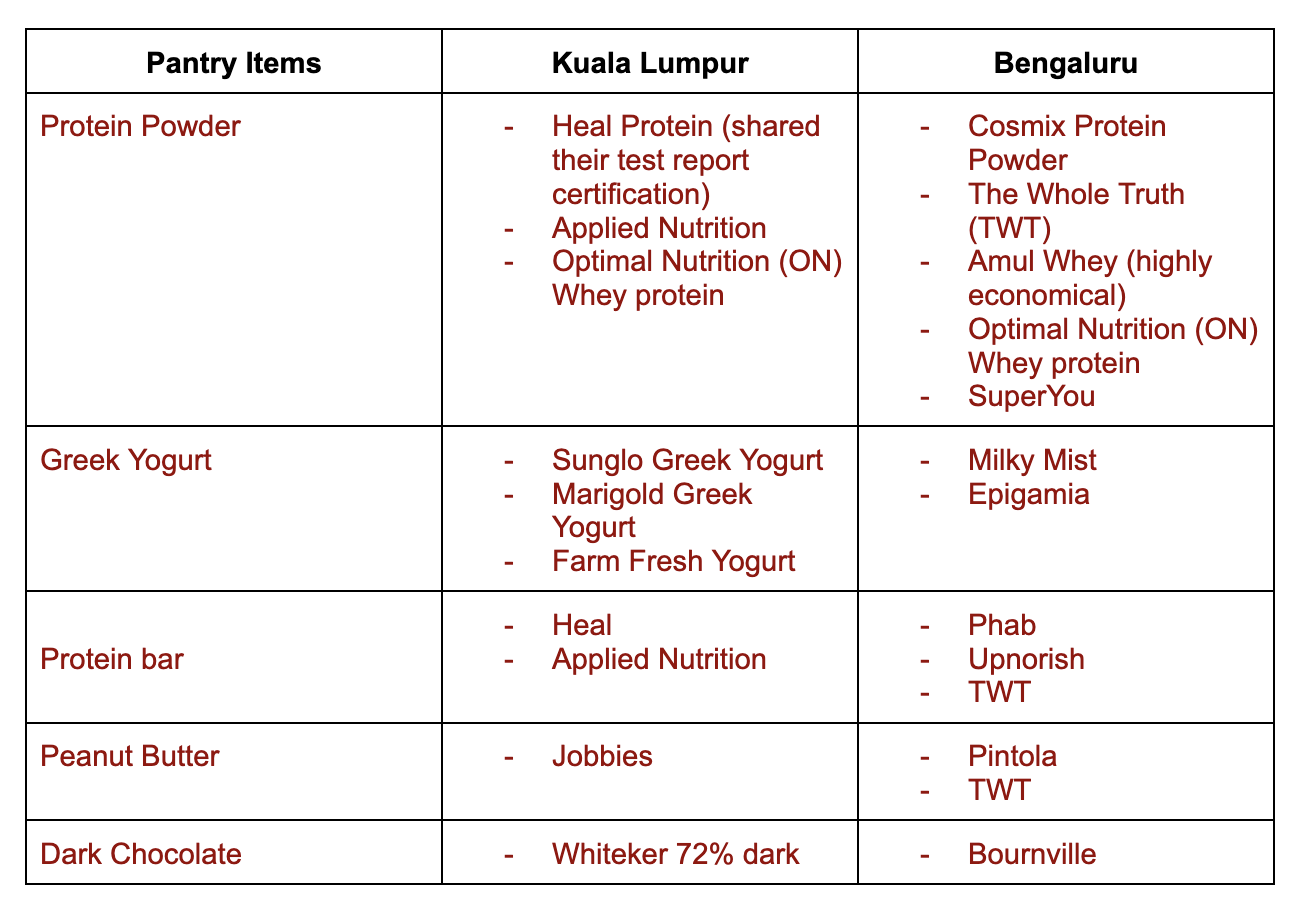
These are products on my research list, not verified one-to-one nutritional equivalents. Availability, prices, formulations, and product ranges may vary.
Some of my observations using these products:
1. Protein content matters more than the front-of-pack claims.
- In my comparison, Optimum Nutrition Whey Protein provided the most protein for the quantities I checked. The calorie content and cost appeared comparable between Optimum Nutrition and The Whole Truth for the products I examined.
- I compared the unflavoured versions, so I won’t comment on taste here. The key takeaway is to compare the actual serving size, protein content, and price rather than relying on the number of scoops or the claims on the packaging.
2. Taste and protein content don’t always go hand in hand.
On taste alone, Heal Protein stood out for me. However, it provided less protein per gram than the other products I compared, while its calorie content was comparable to SuperYou.
That doesn’t automatically make one product better than another. Taste, convenience, protein requirements, and cost all play a role in deciding what works for everyday use.
3. Look for evidence behind quality claims.
Heal Protein publishes product-testing information on its website, which caught my attention during my research. When evaluating such claims, I would look for the specific product tested, the parameters measured, the testing laboratory, and the date of the report.
A published test report can be useful, but its scope matters. It is worth distinguishing between a report that verifies specific quality or safety parameters and one that establishes a product’s overall nutritional value.
What I look for when comparing everyday products
My approach changes slightly depending on what I’m buying.
- Protein powder: Protein per serving, calories, ingredients, price per serving, and available testing information.
- Greek yogurt: Protein, sugar, ingredients, serving size, and price per 100 g. I also check whether the product is genuinely comparable to the Greek yogurt I used back home.
- Protein bars: Protein, calories, added sugars, ingredients, and whether the bar is convenient enough to justify its cost.
- Peanut butter: Ingredients, fat and energy content, serving size, and price per 100 g.
- Dark chocolate: Cocoa percentage, ingredients, sugar content, and how the portion fits into my overall diet.
There is no single label number that tells the whole story. A higher-protein product may be useful for one person, while another may prioritise taste, affordability, or a particular ingredient profile.
The objective isn’t to find the perfect product. It’s to make an informed choice that works for your needs.
Help me discover your everyday staples
I’m still exploring the supermarket aisles in KL and would love to discover more local brands that are healthy, affordable, and practical for everyday use.
If you’ve found a good Malaysian alternative to a familiar Indian product or a locally produced brand that offers great value, please share it with me.
I’m especially interested in products that make everyday nutrition easier without making the grocery bill unnecessarily expensive.
After all, the goal isn’t to build the fanciest pantry. It’s to build one we can sustain. You can reach me at [email protected]